
Is It Legal to Sell Perfume From a Vending Machine? The Rules That Actually Apply
Yes, and no alcohol licence is involved. Perfume is regulated as a cosmetic in every market we ship to, not as an alcoholic product, so the rules that apply to a perfume vending machine are cosmetic rules: someone must be the named responsible party for the product, it must be notified to the right authority before it goes on sale, and it must be labelled correctly. Three separate things trip operators up, and none of them is the licence they were worried about: who owns the compliance for the liquid, whether the fragrance is yours to sell under that name, and how the refill stock legally reaches you, because in freight terms perfume is a flammable liquid.
What follows is a practical map, not legal advice. We manufacture the machine; the fragrance regime in your country is a question for a local adviser or the distributor who supplies your stock.
Why people ask the alcohol question at all
Because fine fragrance really is mostly alcohol. Eau de parfum and eau de toilette carry their fragrance oils in ethanol, which is why perfume evaporates on skin, why it burns, and why freight carriers treat it as dangerous goods. That last consequence is real and we will come back to it.
What does not follow is licensing. Liquor licensing regulates alcohol intended for drinking, sold for consumption, usually with an age gate attached. A cosmetic sprayed onto skin sits under a different body of law entirely, and in the EU, the UK, the United States and the Gulf that body of law is cosmetics regulation. We have never had an operator in 53 countries come back to us needing a liquor licence for a Perfume Station.
What the machine is actually doing, legally
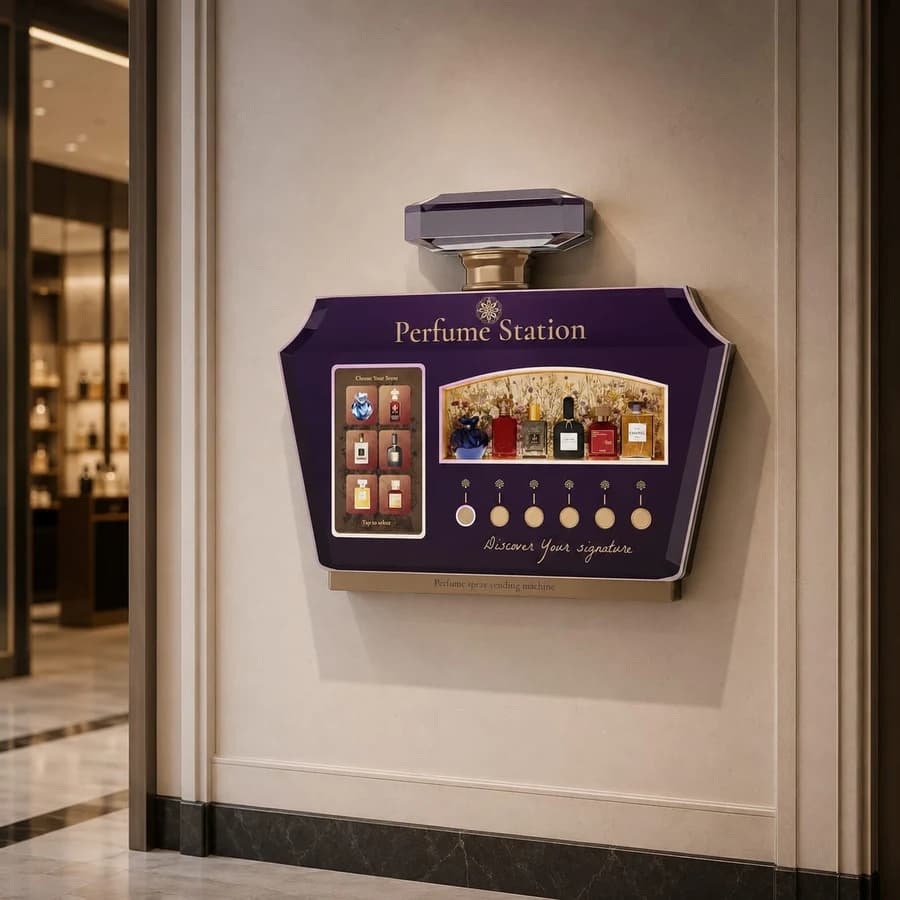
The Perfume Station holds 1,000 or more spray doses across 6 nozzles, mounts on a wall or an optional floor stand, draws 25 watts, and sells for $1,400 factory-direct. The customer picks a scent on the screen, pays by card or QR code, and receives a spray. Nobody walks away with a bottle.
That detail matters more than it looks. You are dispensing a cosmetic directly onto a member of the public, which means the liquid in that reservoir has to be a product that is legally on the market in your country, in its own right, before it ever goes into a machine. The machine does not change the product's status in either direction. There is no regulatory shortcut in selling by the spray, and no extra burden either.
The European Union: notification before sale
In the EU, cosmetics fall under Regulation (EC) No 1223/2009. Two obligations decide whether your fragrance may be sold at all. First, every product needs a Responsible Person established inside the EU, a named legal entity that holds the product information file and answers to the authorities. If you are buying from an EU distributor, that role usually already exists and sits with them. If you are importing fragrance yourself, you have just become that person.
Second, the product must be notified through the Cosmetic Product Notification Portal before it goes on the market, along with a safety assessment and compliant labelling that declares the regulated fragrance allergens. The practical consequence for a vending operator is simple: ask your fragrance supplier for the CPNP notification reference and the name of the Responsible Person. A supplier who cannot produce either is not a supplier you want feeding a machine in a public place.
The United Kingdom, and the Northern Ireland split
Great Britain runs its own version of the same idea. Products sold in England, Scotland and Wales are notified to the Office for Product Safety and Standards through the Submit Cosmetic Product Notifications service, and each product needs a UK-based Responsible Person. Northern Ireland remains aligned with the EU regime and is notified through the CPNP instead. Failing to notify is a criminal offence rather than a paperwork slip, which is worth knowing before you improvise.
An operator running machines in both Dublin and Manchester is therefore dealing with two notification systems for the same bottle. That is annoying and it is also entirely normal; distributors in both markets handle it routinely.
The United States: registration and listing
US cosmetics are overseen by the FDA, and the Modernization of Cosmetics Regulation Act changed the baseline. Manufacturers and processors of cosmetics distributed in the US must register their facilities and submit a cosmetic product listing, with the listing covering ingredients including fragrance components. Foreign facilities must designate a US agent. As of early 2026 the FDA had not yet issued the fragrance allergen labelling rule the Act calls for, so allergen disclosure on US labels is still moving.
None of that lands on the machine owner if you buy finished, compliant fragrance from a US supplier. It lands squarely on you if you decide to import your own fragrance and fill the machine yourself, which is a manufacturing and importing decision dressed up as a stocking decision.
The Gulf and everywhere else
Gulf markets operate their own cosmetic notification systems, with Saudi Arabia's SFDA running the Kingdom's cosmetic product notification. In our experience across the region, operators do not deal with the regulator directly: they buy from a locally licensed importer who already carries the registrations, which is both faster and considerably cheaper than becoming an importer yourself for a handful of machines. The same pattern holds in most markets outside Europe and North America.
| Market | What the fragrance needs | Who normally holds it |
|---|---|---|
| EU | EU Responsible Person, CPNP notification, safety assessment, allergen labelling | The EU distributor or brand owner |
| Great Britain | UK Responsible Person, SCPN notification to OPSS | The GB distributor or brand owner |
| Northern Ireland | EU regime, notified through CPNP | The distributor placing it on the NI market |
| United States | FDA facility registration and product listing, US agent for foreign facilities | The manufacturer or importer of the fragrance |
| Gulf states | National cosmetic notification, typically via a licensed local importer | The local importer |
| Everywhere | The machine itself: CE, plus country certificates on request | Futureino |
The risk that actually catches operators: whose brand is it
The legal question operators lose sleep over is the licence. The one that costs them money is trademark. Buying genuine designer bottles at retail, decanting them into a machine reservoir and selling sprays under that brand name is not the same transaction as reselling the sealed bottle, and whether it is permitted depends on your agreement with the brand or its authorised distributor rather than on anything the machine does. Selling a counterfeit is simply illegal, everywhere, and a machine in a mall is an extremely visible place to do it.
There are two clean routes. Run your own brand, or run a white-label fragrance from a house that supplies the product with its compliance paperwork attached. Both let you answer the venue's legal team in one sentence. Which scents actually sell once that is settled is a separate and much more enjoyable question, covered in what perfumes to stock in a vending machine.
Getting the stock to the machine
Here is where the alcohol content genuinely bites. Alcohol-based fragrance ships as UN 1266, perfumery products with flammable solvents, a Class 3 flammable liquid under the international transport rules used by air, sea and road carriers, in packing group II or III depending on the formulation. That means declared dangerous-goods paperwork, compliant packaging and, on air freight, quantity limits and a surcharge.
The practical answer for an operator is to buy refill stock inside your own market and let the supplier deal with it. Importing a pallet of fragrance yourself to save a margin is a dangerous-goods shipment with your name on the declaration. Worth doing at scale, rarely worth doing for your first machine. It is also worth asking the venue where refill stock will be stored, because a fire officer has views about flammable liquids in a back room that they do not have about a wall-mounted machine.
A compliance checklist you can run in a day
Ask your fragrance supplier for the notification reference in your market and the name of the responsible entity. Confirm in writing that you may sell their product by the spray from an automated dispenser, because a supply agreement written for bottle retail may not contemplate it. Confirm the brand position: own-label, white-label or authorised. Check the venue's own rules on cosmetics and on storing refill stock. Then handle the ordinary business paperwork that has nothing to do with perfume, which is set out in the guide to vending machine licences and permits.
On our side of the line the answer is short. The machine carries CE, additional country certificates can be obtained on request, and the mechanism itself is described in how a perfume vending machine works. If you are still choosing hardware, the market survey lives in the best perfume vending machines compared.
Frequently Asked Questions
Do I need an alcohol licence to sell perfume from a vending machine?
No. Fine fragrance is ethanol-based, but alcohol licensing regulates drinks intended for consumption. Perfume is regulated as a cosmetic in the EU, the UK, the US and the Gulf markets, so a liquor licence is not part of the picture anywhere we ship. The rules that do apply are cosmetic notification, labelling and ordinary trading rules.
Who is legally responsible for the perfume in the machine?
Not the machine manufacturer. In the EU and the UK a cosmetic product needs a named Responsible Person established in that market, and that role attaches to whoever places the product on the market. If you buy fragrance from a local distributor who already holds that role, you inherit their compliance. If you import it yourself, the role is yours.
Is perfume dangerous goods for shipping?
Yes, for freight. Alcohol-based fragrance ships under UN 1266, perfumery products with flammable solvents, Class 3 flammable liquid, in packing group II or III depending on the formulation. That affects how your refill stock reaches you by air, sea or road. It has no bearing on whether you may sell it once it is there.
Can I put branded designer perfume in the machine?
Only with a supply agreement that permits it. Decanting a branded bottle into a machine reservoir and selling sprays under that name raises trademark and cosmetic labelling questions that are decided by your agreement with the brand or its authorised distributor, not by the machine. Own-brand and white-label fragrance avoids the question entirely.
Is there a minimum age to buy a spray of perfume?
We are not aware of a market that age-restricts fragrance the way it restricts alcohol or tobacco. Some venues apply their own policies regardless, and a venue rule is worth confirming in the placement agreement so it does not arrive as a surprise after installation.
Does the Perfume Station need any certification of its own?
The machine carries CE, and additional country-specific certificates can be arranged on request, with the cost carried by the client or by us on a large order. That certification covers the machine as a piece of equipment. The fragrance inside it is a separate regulated product with its own paperwork.
Ask us what the machine side needs
Tell us your country and your venue and we will confirm exactly what certification ships with the machine, what we can obtain on request, and what stays on your side of the line.