
Cotton Candy Vending Machine Flavors, Colors and Shapes: What the Robot Can Actually Make
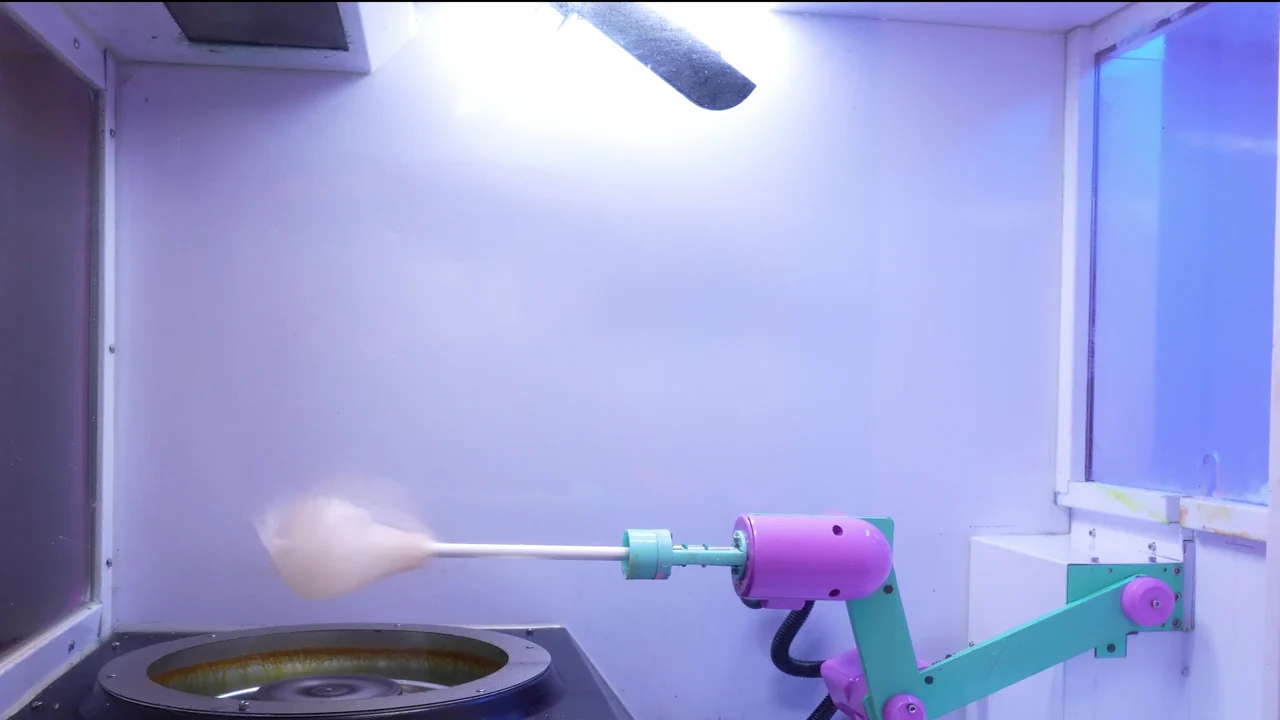
Four colors, more than 100 shapes, and one honest catch: flavor is not a machine setting. The Cotton Candy Robot spins 200 servings per fill at about 180 seconds each, drawing the floss onto the stick along a programmed path, and it will happily make any flavor you can buy as flossing sugar. Colour and flavour arrive together in the same bag. So the real question behind this one is not what the robot can do, it is which flossing sugars your local food supplier stocks, and which four you want running at any given time.
What the machine decides, and what you decide
| Element | Set by | Detail |
|---|---|---|
| Number of colors live at once | The machine | Four |
| Which colors and flavors those are | You | Whatever flossing sugar you load |
| Shapes available | The machine | Over 100 programmed arm paths |
| Servings per fill | The machine | Around 200 |
| Time per serving | The machine | About 180 seconds, including the arm performance |
| Price per serving | You | $4 to $6 is the typical venue range we see |
| Consumable cost | Your supplier | Sugar and stick, measured in cents per serving |
Everything in the operator column is reversible in an afternoon. Everything in the machine column is fixed at purchase. That is worth reading twice before anyone worries about flavour range: the flavour list is the easiest thing in this business to change your mind about.
Why four colors and not twelve
Four is a merchandising decision as much as an engineering one. A four-colour palette gives every customer a real choice while keeping four bags of sugar in rotation instead of a dozen part-used ones going stale in a store cupboard. Cotton candy is bought on impulse and on looks, and a screen offering four vivid options converts better than one offering fifteen that require reading.
Operators who want variety get it from rotation rather than from capacity. Run a fixed pair that never changes and swap the other two by season, and the machine feels new to regulars four times a year without the stock headache. That is the pattern we see working in mall placements, where the same shoppers pass the same machine every weekend.
The shapes are the product
Over 100 shapes sounds like a specification line and behaves like a marketing department. The arm winds the floss along a programmed path to build flowers, hearts, mushrooms, butterflies and dozens more, and it does it behind oversized transparent panels so the drawing is visible from across a concourse. The three minutes a customer waits are not dead time. They are the show that pulls the next two customers into the queue, which is exactly why the same product sells for $4 to $6 from a robot and considerably less from a cart.
A practical note from installs: shape choice slows people down at the screen, which is good for the crowd and bad for throughput at peak. If your venue has genuine rush periods, consider promoting two or three shapes on the screen rather than presenting the whole catalogue. The mechanics of the spin and the arm are broken down in how a cotton candy vending machine works.
Choosing the sugar
Ready-flavored flossing sugar is the practical choice for an automated machine. It arrives coloured and flavoured, it feeds by dose, and there is no manual mixing step for anyone to get wrong at 11pm. The alternative used on carts, plain sugar plus a separate flavour and colour concentrate, exists because a human operator is standing there adjusting it. In a machine that runs unattended for two weeks, that human is not available.
One request, and it comes from experience rather than from a rulebook: test any new sugar on the machine before you buy a season of it. Sugars differ in how they melt and how they spin, and the difference shows up in the density of the floss on the stick, which is the only thing your customer actually evaluates. Buy one bag, run ten servings, look at them. It is a twenty-minute test that has saved operators a pallet of the wrong product.
Palettes that work in real venues
| Venue | Palette approach | Why |
|---|---|---|
| Shopping mall, year-round | Two permanent classics plus two seasonal | Regulars see something new without you managing eight SKUs |
| Cinema and family entertainment | Maximum colour contrast on the screen | Bought in the dark, on impulse, by children choosing quickly |
| Corporate and branded events | Two colours matched to the brand, two crowd-pleasers | The branded pair photographs; the other two keep everyone happy |
| Amusement park, summer peak | Fastest-selling four, no experiments | At peak throughput a slow-moving colour is a wasted hopper |
Whichever palette you run, the venue matters more than the colours. Where these machines actually earn is set out in the best locations for a cotton candy vending machine.
Working out your cost per serving
We are not going to publish a sugar price, because ours is not your price. Yours depends on your supplier, your currency and how much you buy at once. Do it in three lines instead. Take the delivered cost of a bag. Divide by the number of servings your supplier states that bag yields. Add the cost of one stick. That is your consumable cost per cone, and against a $4 to $6 selling price it will be a rounding error next to your venue rent.
Which is the real point of the exercise. Operators new to this category spend a surprising amount of energy optimising the cheapest line on the sheet. The lines that decide whether the machine works are the venue deal and the daily sales count, both of which are modelled properly in the cotton candy profit breakdown.
Colours, labels and the paperwork nobody reads
The floss is a food, so it carries a food supplier's obligations rather than a machine manufacturer's. Permitted food colours are not identical across the EU, the UK and the United States, and neither are allergen declaration rules. Ask your sugar supplier to confirm in writing that their product is compliant in the market where the machine stands, and keep the specification sheet where you can find it if a venue or an inspector asks. That request takes one email and it is the single most useful piece of admin in this category.
The other question venues ask, usually about children, is answered separately in are cotton candy machines safe for kids.
The smaller sibling
Not every site justifies the full robot. The compact Cotton Candy Truck holds about 100 servings, runs a 120-second cycle and sells for $2,500 to $2,800 factory-direct, against $5,500 to $5,800 for the Cotton Candy Robot with its 200-serving fill and Ferris wheel display. The consumable question is identical on both: the same flossing sugar, the same four-colour discipline, the same twenty-minute test before you commit to a supplier. What changes is how long a fill lasts and how much of a crowd the machine draws on its own.
What to line up before the machine lands
Four things, and none of them are exciting. Find your flossing sugar supplier before the machine arrives rather than after, because a robot with no sugar is furniture and food suppliers do not deliver on the same day you call them. Buy sticks in the same order. Decide your four colours and order them in a quantity you can sell through, not a quantity that earns a discount. And keep the sugar somewhere dry, because humidity is the enemy of every sugar-spinning machine ever built, which is also why our maintenance guide spends as much time on the storeroom as on the machine.
On our side, a free spare-parts package ships with every machine, and additional packages are worth buying upfront if you are running more than one unit. Parts ship from Guangzhou in 7 to 14 days depending on the country, which is fine for planned work and slow for a machine standing idle in a mall on a Saturday.
Frequently Asked Questions
How many flavors can a cotton candy vending machine hold?
The Cotton Candy Robot runs four colors, and in practice a color and a flavor arrive in the same bag of flossing sugar, so four colors means four flavors. The machine does not blend or dose flavor separately. Whatever the sugar is, that is what the customer tastes.
Can I choose my own cotton candy flavors?
Yes, within what your local food supplier sells as ready-flavored flossing sugar. The machine is agnostic about brand. What we ask is that you test a new sugar on the machine before committing a season's stock, because different sugars spin differently and the result on the stick is what your customer judges you on.
How many shapes can the robot make?
Over 100. The arm winds the floss onto the stick along a programmed path, so a shape is a pattern rather than a mould. Flowers, hearts, mushrooms and butterflies are the recognisable ones, and the drawing itself is half the reason people stop to watch through the viewing window.
What does one serving of cotton candy cost the operator?
Cents, in sugar and a stick. The exact figure is arithmetic only you can do: take the price of a bag from your supplier, divide by the servings that bag yields, and add the stick. Against typical venue pricing of $4 to $6 a serving, the consumable is the smallest line on the sheet.
Are the colors safe and legal in my market?
The colors come from your flossing sugar, which is a food product regulated by your own market's food colour rules, not by the machine. Permitted colours differ between the EU, the UK and the US, so ask your sugar supplier to confirm their product is compliant where you are selling it and keep their specification on file.
How many servings does one fill hold?
Around 200 on the Cotton Candy Robot, spun at roughly 180 seconds per serving. The compact Cotton Candy Truck holds about 100 servings at a 120-second cycle. At 15 sales a day a full robot carries more than two weeks of trading between visits.
Ask us about your colour lineup
Tell us the venue and the market and we will talk through the four-colour setup, the sugar formats the machine handles well, and what ships with the machine on day one.