
How to Write a Vending Machine Business Plan That Holds Up
A vending machine business plan that survives contact with reality is about two pages long and it turns on one number: landed cost, not the machine price. Our catalogue runs $1,400 to $6,800 EXW Guangzhou, and every plan we see quotes that figure as if it were the cost of a working machine standing in a mall. It is not. Freight, import duty, VAT or GST, customs clearance, first stock, and the install itself sit between the two, and the plans that fail are the ones where those lines are blank.
The eight sections a plan actually needs
Skip the template. A vending plan is a sequence of decisions, each one constraining the next, and it reads best in this order:
- The concept, in one line.
- The machine, and why that machine.
- Startup capital, ending in landed cost.
- Location strategy: own the site or share the revenue.
- Unit economics per machine.
- Break-even, in months.
- Operating cadence: who refills it, how often.
- Risks, written honestly.
Notice that seven of the eight are downstream of the machine choice. That is why people who write the plan before choosing hardware end up rewriting it.
One line, not a mission statement
Write the concept as a sentence a venue manager would repeat back to you. Not "an automated retail solution for the experiential economy". Try "a robotic candy machine in the food court of one mall, opening June, paying the mall 15% of sales". If you cannot name the venue type, the city, and the month, you are not ready for the numbers section.
The machine choice decides everything after it
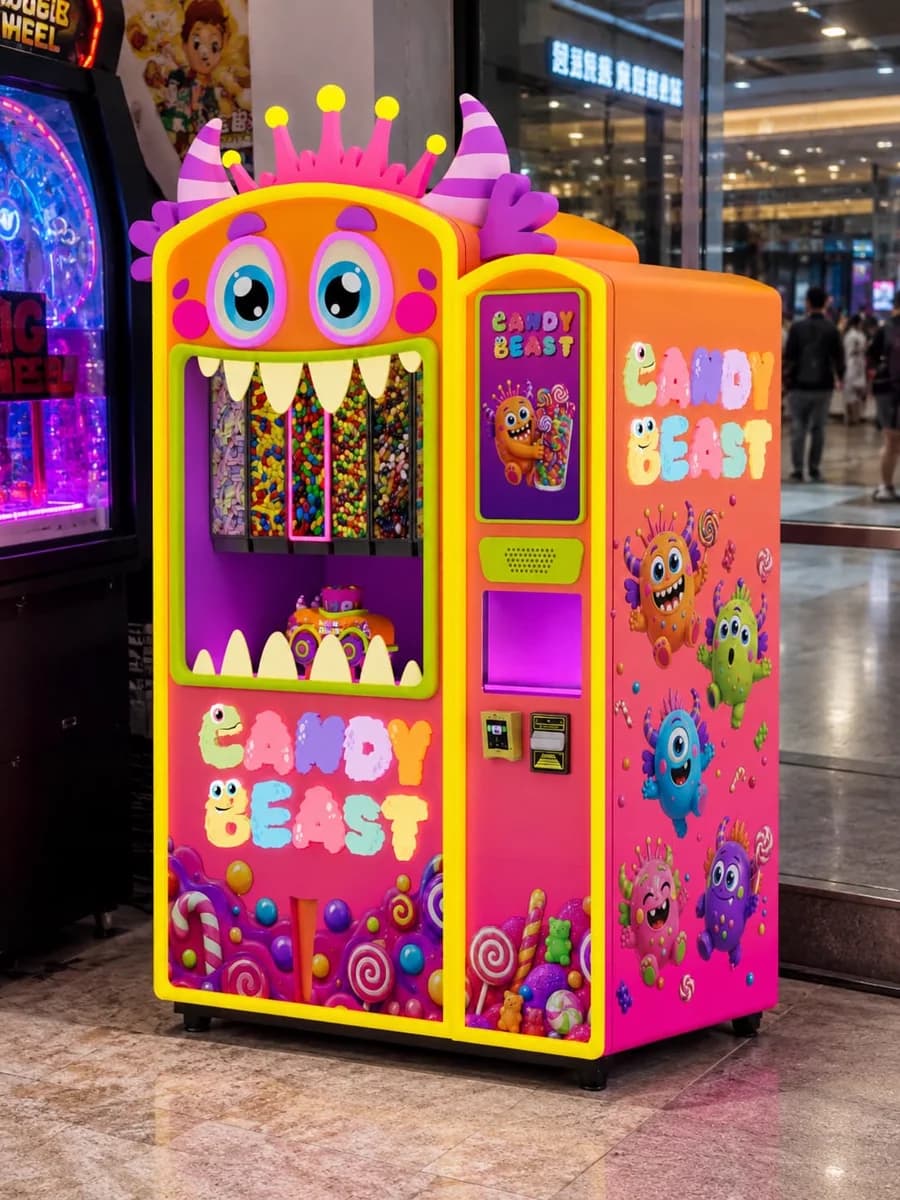
Pick the machine first, because it fixes your capital, your refill schedule, your ticket price, and even the kind of venue that will take you. A Perfume Station at 888 × 210 × 670 mm and 25W hangs on a wall in a salon. A Candy Beast at 1370 × 830 × 2350 mm and 1,320W needs a food-court footprint and a doorway to get through. Those are two entirely different business plans wearing the same title.
| Machine | Factory price (EXW) | Capacity per fill | Power draw | What the plan inherits |
|---|---|---|---|---|
| Perfume Station | $1,400–$1,600 | 1,000+ spray doses | 25W | Lowest capital, wall-mounted, refills measured in months |
| Popcorn Bot | $2,500–$3,100 | 70 cups | 2,000W (18A at 110V) | Fresh-made food, 90-second cycle, needs a real circuit |
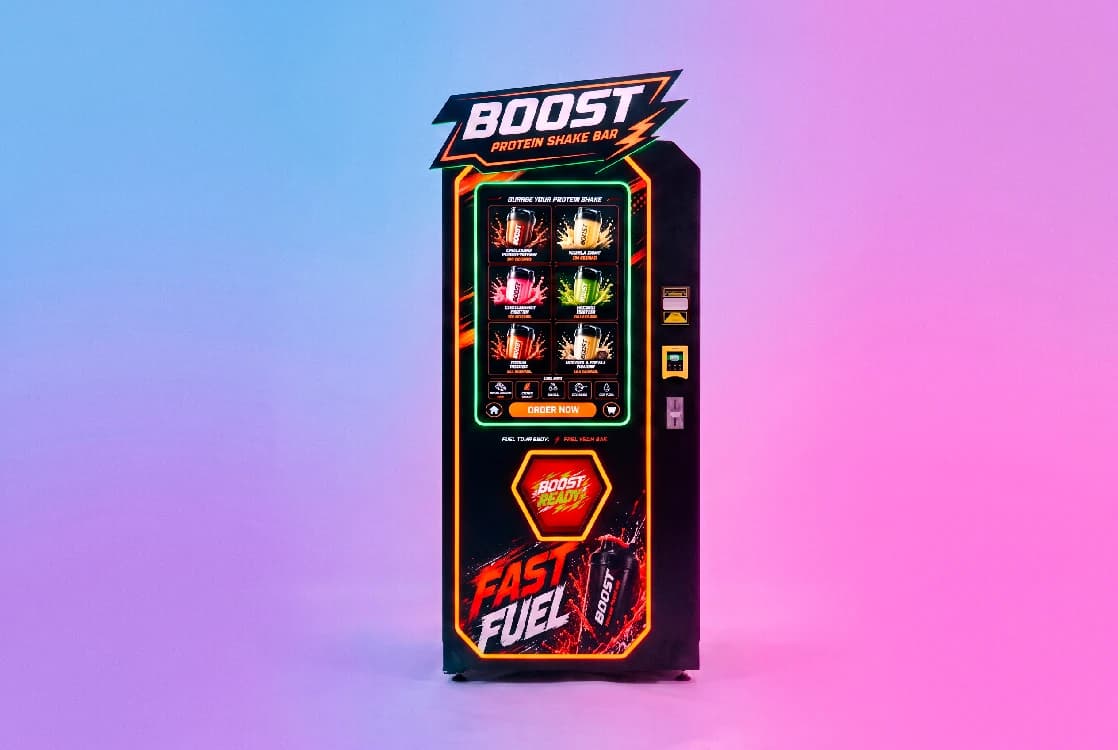
| Boost Protein Shake Bar | $3,600–$4,000 | 312 cups, 8 canisters | 2,200W (20A at 110V) | Gyms and offices, weekly refills, voltage decision at quote stage |
| Candy Beast | $6,000–$6,800 | 300 cups in the machine, bins hold about 900 | 1,320W (12A at 110V, 6A at 220V) | Highest ticket, 30-second cycle, mall and FEC venues only |
Read the full range on the robotic vending machine catalogue before you commit, and if you are still weighing categories, our comparison of the most profitable vending machines ranks them by margin rather than by price.
The startup capital table
This is the table a lender reads first. Build it as line items, and mark which ones you can fix today and which ones depend on your country. Honesty here is what makes the rest of the document credible.
| Line item | Basis | Can we quote it? |
|---|---|---|
| Machine, EXW Guangzhou | $1,400 to $6,800 depending on model | Yes, published on every product page |
| Sea freight to your port | Crate volume, destination port, container sharing, season | Quoted per order, not publishable |
| Import duty | Your country's tariff on automatic vending machines | No, ranges from zero to double digits by country |
| VAT or GST on import | Applied to machine plus freight plus duty | No, 5% in the Gulf, 10% in Australia, 20%+ across much of Europe |
| Customs clearance and inland delivery | Broker fee, port charges, truck to the venue | Your broker, in one phone call |
| First stock | One full fill plus one spare fill | Yes, from the consumable cost per serving |
| Spares kit | Wear parts you do not want to air-freight later | Yes, we spec it per model |
| Install | Electrician if the circuit needs work, signage, permits | Local, and usually underestimated |
If you want the per-model price detail behind row one, it is all in how much vending machines cost. This post is about the document, not the price list.
Landed cost: the section almost every plan skips
A machine bought EXW Guangzhou is a machine sitting in our factory. Ownership transfers there. Everything between our loading dock and your venue is yours to plan, and it is the single most common reason a first-year budget breaks.
Sea versus air. Sea is the default for anything with a full-height cabinet, and it is the only sane choice for a Candy Beast or a Popcorn Bot. Air freight on a two-metre crate costs multiples of sea and rarely makes commercial sense. The exception is small units. A Perfume Station at 888 × 210 × 670 mm can go by air when a launch date matters more than the freight bill.
The payment and production clock. A 40% deposit starts production. Production runs about 30 days. The balance is paid before shipment. Then sea transit and customs clearance add weeks that vary by lane. Your cash-flow section needs that whole gap in it, because you are paying for a machine that is not earning yet.
Duty, VAT, and paperwork. We supply the commercial invoice, packing list, and certificate of origin. Your broker classifies the machine and tells you the duty rate. That rate is genuinely country-specific and anyone who quotes you a single global percentage is guessing. VAT or GST is then charged on the total landed value, not on the machine price, which catches people out.
Install realities. Voltage is chosen before production, not after delivery. The Boost Protein Shake Bar draws 2,200W, which is a comfortable 12A on 220V and an awkward 20A on 110V that a standard North American circuit will not carry. Candy Beast is easier at 12A on 110V. Then measure the route in: we have seen mall installs where the machine cleared the service corridor by centimetres, and one where it did not and a door frame came out.
Own the site, or share the revenue
Two structures, and the plan has to pick one. Renting your own spot means a fixed monthly cost and all the upside. Placing inside someone else's business means no rent, their foot traffic, and a share of sales going to the host, usually somewhere between 10% and 25% depending on how much traffic they bring.
Revenue share is the safer opening position for a first machine because your downside is capped at the machine sitting idle rather than at rent you still owe. Fixed rent wins once you know the location performs. The venue-selection logic behind both sits in our guide on where to put a vending machine, and the two operating paths are laid out on the vending machine business model page.
Unit economics and break-even
One machine, one column. Servings per day, price per serving, consumable cost per serving, location fee, and what is left. Do not blend three machines into an average until you have three machines.
Break-even should be expressed in months and stated twice: once at your expected volume and once at half of it. A plan that only survives the optimistic case is not a plan. Real revenue benchmarks by machine type are in how much vending machines make, and the ROI calculators on each product page let you run your own numbers rather than borrow ours.
Operating cadence: who drives to the machine
This is the section that separates plans written by operators from plans written by spreadsheets. Capacity per fill and expected daily volume give you refill frequency directly.
A Boost bar holds 312 cups. At 15 drinks a day that is a weekly visit. A Candy Beast holds 300 cups in the machine and about 900 cups worth of candy across its six bins, so a busy mall unit is a once or twice weekly stop. A Perfume Station at 1,000+ doses might go a month. Multiply by your travel time, then answer the real question: is that you at 7am, or a part-time person you have not hired yet? Write the name or write the wage.
The risks section, written like an adult
Four risks matter for an imported machine business, and each has a mitigation that fits in one sentence.
- Losing the location. The machine is movable. Keep a second venue warm and a lost site becomes a two-day relocation.
- Seasonality. Mall and tourist traffic swings hard. Plan twelve months, not your best month multiplied by twelve.
- Currency and freight movement. You are importing. Lock the machine price at deposit and treat freight as a variable until it is booked.
- Downtime. Parts ship from Guangzhou. A spares kit bought with the machine costs far less than an air-freighted part bought in a panic.
Every reviewer of your plan is silently checking whether you have thought about what goes wrong. Answering before they ask is worth more than another page of projections.
For the capital side by tier, see what $5,000, $10,000 and $25,000 actually buy, landed costs included.
Two lines most plans miss: insurance and payment processing fees.
Frequently Asked Questions
What should a vending machine business plan include?
Eight sections: the one-line concept, the machine you chose and why, a startup capital table that ends in landed cost, the location plan, unit economics per machine, break-even in months, the weekly operating cadence, and risks. Anything longer is padding. Two pages of real numbers beats twenty pages of template.
How do I estimate landed cost before I have a freight quote?
Take the EXW price, then budget separately for sea freight, import duty, VAT or GST, and customs clearance. Duty and tax are the country-specific part and your customs broker can confirm them in a phone call. Freight we quote per order once we know your port and how many machines share the container.
How many machines should the plan start with?
One, unless you already control the locations. One machine teaches you refill frequency, which flavours sell, and what your venue actually pays. Machine two should be funded partly by machine one. Buyers who order six units before placing the first usually end up storing three of them.
How long does the plan take to go from signed to earning?
A 40% deposit starts production, production runs about 30 days, the balance is paid before shipment, then sea freight and customs add several weeks depending on your port. Budget roughly two to three months from deposit to first sale, and put that gap in the cash-flow section.
Do banks and investors accept a vending machine business plan?
They accept plans with a signed or verbally agreed location and a landed-cost figure that includes freight and duty. What gets rejected is a plan quoting a factory price as though it were the delivered cost, because the reviewer knows a shipped machine costs more than an EXW machine.
What belongs in the risks section?
Location loss, seasonality, currency movement on an import, and consumable supply. Write the mitigation next to each one. A machine is movable, so a lost location is a relocation, not a write-off. That single sentence answers the question every reader of the plan is silently asking.
Build the plan on real factory numbers
See the two operating models, the ROI math, and the venue types that work, then send us your country and your target machine and we will give you a landed-cost picture instead of a factory price.