
The Snack Vending Machine Business: What One Machine Actually Earns
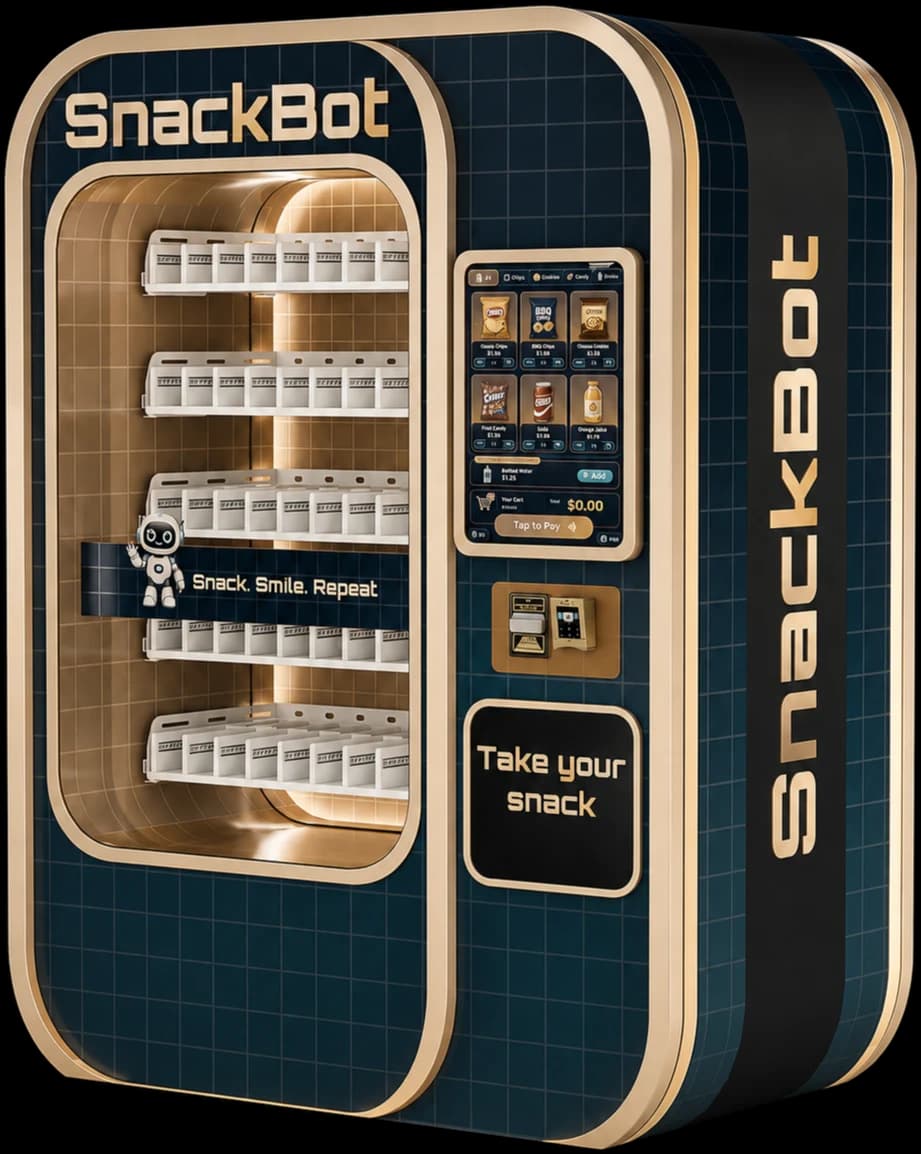
A snack vending machine in a decent venue sells 20 to 40 items a day at around $2 each, which is $1,200 to $2,400 a month across the counter and roughly $700 to $1,400 once you have paid for the stock. The machine costs $3,300–$4,000 EXW factory-direct and holds 320 items, so most sites clear the hardware in six to twelve months. The honest caveat: packaged goods leave you 55 to 65 cents on the dollar, not the 85 to 90 cents you get from a machine that makes the product on the spot. The snack business is a volume business, and you should go into it knowing that.
What one machine is, in numbers
The Snacks Bot we build in Guangzhou holds 320 items, stands 2.07 m tall, and takes up 1.57 m of wall by 0.88 m of depth. It draws 380W, which is 4A on 110V and 2A on 220V, so it goes into an ordinary wall socket. No dedicated circuit, no plumbing, no drain, no permit in most jurisdictions. Card and QR payment is standard and there is no coin box to empty.
Factory price is $3,300–$4,000 EXW Guangzhou. Production runs about 30 days once a 40% deposit lands, and the balance is due before shipment. Full specs and current pricing for it and the rest of the shortlist sit on our best vending machines page.
The margin nobody wants to say out loud
You are reselling something a factory in another country already made and already took a margin on. That sets your ceiling before you place the machine.
| Line | Wholesale cost | Machine price | You keep |
|---|---|---|---|
| Chocolate bar | $0.70 | $2.00 | $1.30 |
| Crisps / chips | $0.55 | $1.80 | $1.25 |
| Protein or cereal bar | $1.10 | $2.50 | $1.40 |
| Nuts / dried fruit | $0.90 | $2.20 | $1.30 |
| Chilled can (Mega Can) | $0.55 | $1.80 | $1.25 |
Call it $1.25 to $1.30 of gross profit per sale as a planning number, then take 2 to 3 percent off the top for card processing. Buying in case quantities from a cash-and-carry rather than a supermarket is worth 15 to 20 percent on the cost column, and that gap is most of the difference between operators who scale and operators who quietly stop after one machine.
Sales per day, by venue type
Venue selection matters more here than in any other category we build for. An experiential machine can create its own demand because people stop to watch it. A snack machine cannot. It sells to people who were already hungry and already walking past.
| Venue | Items / day | Gross profit / month | Why it behaves this way |
|---|---|---|---|
| Hotel lobby or small B&B | 8 to 15 | $300 to $580 | Low headcount, guests eat out, but late-night demand is captive |
| Office breakroom, 100+ staff | 15 to 30 | $580 to $1,150 | Five weekdays only, and holidays flatten August and December |
| Gym or leisure centre | 20 to 35 | $770 to $1,350 | Bars and drinks skew high value, evening peaks |
| Student housing or campus corridor | 30 to 50 | $1,150 to $1,900 | Seven days, late hours, but dead for three summer months |
| Hospital or 24-hour shift site | 40 to 60 | $1,500 to $2,300 | The canteen closes, the machine does not. The strongest snack venue we see |
| Mall corridor with a shop 60 seconds away | 5 to 12 | $190 to $460 | You are competing with a wider range at a lower price. Avoid |
That last row is the one to internalise. The single best predictor of a bad snack site is a convenience store within a minute's walk. Our guide to where to put a vending machine goes deeper on footfall and landlord deals, and if the site you have in mind is a workplace, the headcount thresholds are in our breakdown of office vending machines.
The real cost is the driving
New operators budget for stock and electricity and forget the line that actually decides whether machine number two happens: their own time.
A 280-item fill sounds like nine days at 30 sales a day. It never is. Four or five lines carry most of the volume and empty first while the slow lines sit there looking full, so in practice you visit weekly, top up the movers, and rotate dates. Add the cash-and-carry run and the drive, and a single machine costs you 60 to 90 minutes a week. Cost that at whatever your hour is worth. At $25 an hour it is $130 to $190 a month, and it is the largest expense on the sheet after the snacks themselves.
Remote inventory monitoring changes the shape of that job. Seeing which slots are low before you leave the house means one trip with the right box in the car instead of two trips with the wrong one. It does not remove the labour. It stops you wasting it.
Why we stopped dropping the chocolate bar
Legacy snack machines dispense with a spiral coil that pushes the item off a shelf so it free-falls into a tray. That single design choice generates most of the operating pain in the category. The item hangs on the coil. The bag catches on the flap. A customer pays $2, gets nothing, and now you owe them a refund and a drive across town. Multiply by a machine that jams a few times a week and the arithmetic gets ugly quickly.
Snacks Bot uses a robot elevator lift instead. A platform travels to the slot, receives the item, carries it down, and presents it through a side-collection window at hand height. Nothing falls two feet. Crisps arrive uncrushed, chocolate arrives unsnapped, and glass or bottled lines become viable in a machine where they previously were not. Jam refunds mostly disappear, and so does the unpaid trip that follows each one.
It also changes what customers buy. When people trust the machine to deliver, they stop defaulting to the cheapest item they will not mind losing, and average transaction value drifts up.
Shrink, melt, and the expiry date
Budget 2 to 4 percent of stock as write-off. It goes up if you over-range. Twelve well-chosen lines outsell thirty lines where twenty of them turn once a month and then expire.
Chocolate is the specific trap. Above roughly 25C it blooms, softens, and looks wrong through the glass even when it is perfectly edible, and nobody buys a chocolate bar that looks wrong. If the machine is going into an unconditioned corridor, a warehouse, or a Gulf lobby in July, load bars, nuts, and crisps and leave the chocolate to a refrigerated machine or a cooler site. That is a stock decision, not a hardware one, and it costs nothing to get right at the start.
Mega Can, when the venue wants cold drinks
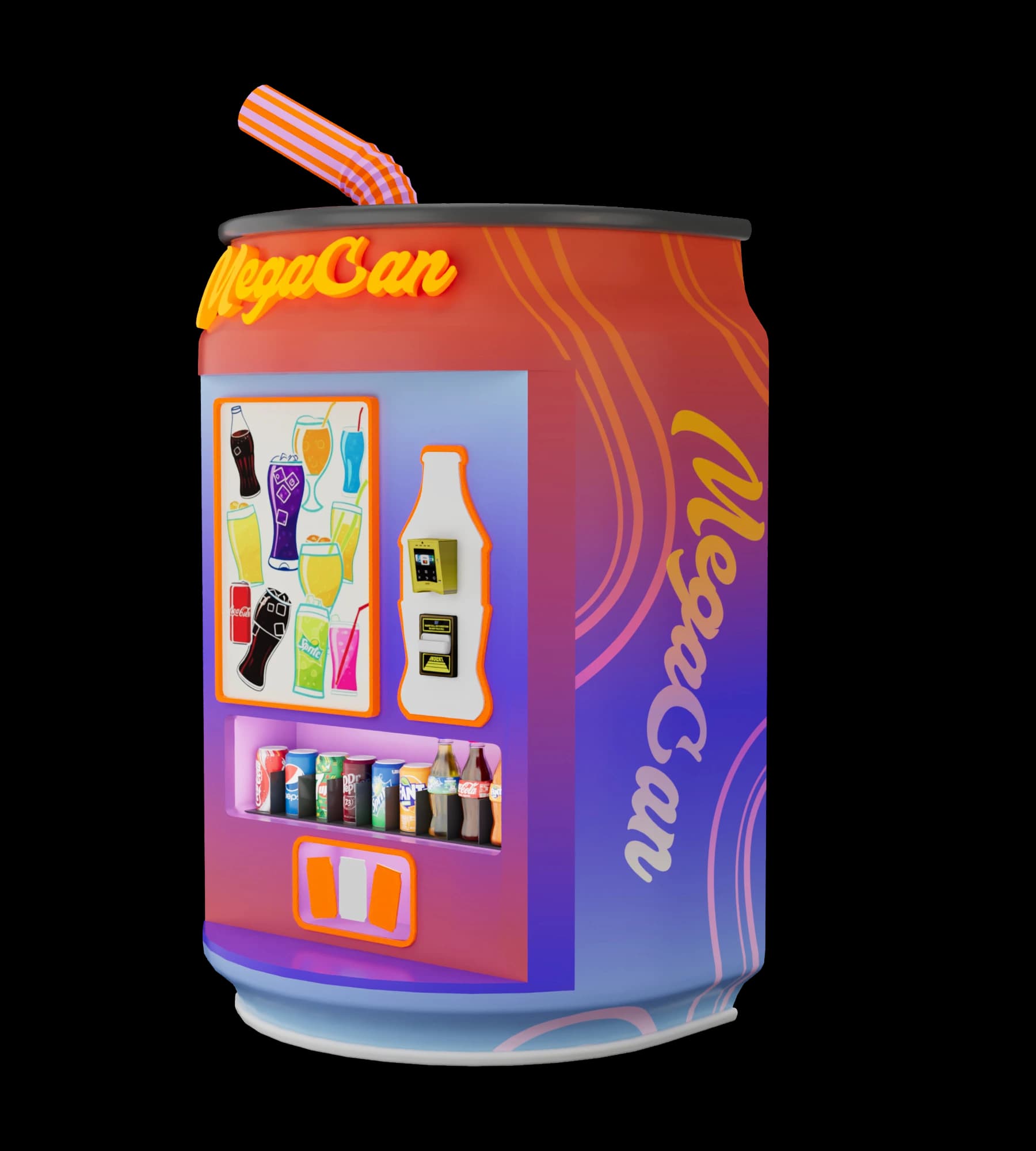
Cans are the other half of this business, and in hot or physical venues they are the better half. Mega Can holds 270 refrigerated cans and bottles, is built as a giant can 2.18 m tall on a 1.28 m by 0.91 m footprint, draws 500W, and costs $4,300–$5,500 EXW. It has a display window and LED stock tracking, and the shape does real work: a machine shaped like a can pulls people across a corridor in a way a rectangular cooler does not.
Two honest differences from a snack machine. The compressor runs continuously, so electricity is a genuine line item rather than a rounding error, typically $20 to $45 a month depending on your tariff and how hot the room is. And the condenser coil needs cleaning in dusty venues. That is the one maintenance job on this machine that people skip and later pay for.
One machine, one month, all the lines
Here is a full sheet for a Snacks Bot in a gym doing 28 sales a day at a $2.05 average. No optimism in it.
| Line | Amount |
|---|---|
| Revenue (840 items at $2.05) | $1,722 |
| Cost of goods (at $0.78 average) | -$655 |
| Card processing (2.5%) | -$43 |
| Shrink and expiry (3%) | -$20 |
| Site fee or revenue share | -$150 |
| Electricity and connectivity | -$25 |
| Restocking labour (4.5 visits, 90 min each) | -$170 |
| Net | $659 |
Against a $3,600 machine plus freight, that is a payback somewhere around seven to nine months, and a machine that keeps earning for years afterwards. It is a good return on a small capital outlay. It is not the return you may have read about on forums where the labour line quietly went missing. The wider cost picture across our range is in how much vending machines cost.
Volume game, margin game
We build both kinds of machine, so we can be blunt about the difference.
A snack machine wins on volume. Nine hundred small sales a month, each leaving you about $1.25, in venues where demand already exists and you simply have to be standing there when it shows up. Low novelty, low drama, low risk, and it works in a corridor that no experiential machine could justify.
A made-fresh machine wins on margin. When the machine spins the cotton candy or mixes the shake in front of the customer, the raw material is cents and the sale is several dollars, so 200 sales a month can net what 900 snack sales net. The tradeoff is that those machines want dwell time, an audience, and a venue that suits a spectacle. Which of the two suits you is really a question about the sites you can get, and we walk through both routes in the Futureino business model. The full lineup, snack and made-fresh, is in the robotic vending machine catalogue.
Plenty of our operators run both. The snack and can machines cover the rent and keep the route dense; the made-fresh machines carry the profit. Starting with a snack machine is a reasonable way to learn the operational side of this business, because everything that will hurt you later, route planning, stock discipline, venue negotiation, hurts you here first and cheaply.
Who should not buy one
Skip it if your only available site has a shop next door, if you cannot commit to a weekly visit, or if you are hoping one machine replaces an income. One snack machine is a few hundred dollars a month. Four on a tight driving loop is a real side business. That difference is the whole strategy.
The snack and drink cabinets themselves come in six sizes, at room temperature, refrigerated or frozen, and are built in our own factory in Guangzhou: see the vending machine manufacturer page.
Frequently Asked Questions
How many items does a snack vending machine sell per day?
Between 8 and 60, and the spread is almost entirely about the venue. A hotel lobby moves 8 to 15 a day. A gym or a large breakroom moves 20 to 35. A 24-hour hospital corridor or a shift factory moves 40 to 60, because the shop nearby is shut when people are hungry.
What profit margin do packaged snacks actually leave?
Around 55 to 65 percent before you pay yourself. An item bought at $0.70 to $0.90 wholesale sells for $1.80 to $2.50, so you keep roughly $1.10 to $1.50. Card fees take 2 to 3 percent of the top line. Nobody in this business gets 90 percent margins on wrapped goods.
How long does one 280-item fill last?
Rarely as long as the arithmetic suggests. At 30 sales a day the maths says nine days, but the four or five popular lines empty first while the slow ones sit. Most operators settle into a weekly visit and top up the fast movers rather than waiting for the machine to run down.
Do modern snack vending machines still jam?
Far less, if the delivery is not a drop coil. Snacks Bot lifts each item on a robot elevator and hands it out through a side-collection window, so nothing free-falls onto a flap. That removes most of the jam refunds and, more importantly, the drive back to the site to clear one.
What happens to snacks that pass their expiry date?
You eat the loss, so plan for 2 to 4 percent write-off. Rotate stock front to back on every visit and check dates on slow lines. Chocolate is the item to watch: above roughly 25C it blooms and softens, so unconditioned corridors and summer lobbies want bars, nuts, and crisps instead.
Snack machine or drink machine for the same spot?
Drinks if the venue is hot or physical, snacks if people linger. Mega Can holds 270 chilled cans at $4,300–$5,500 and costs more to buy and to run because the compressor never stops. Snacks Bot is $3,300–$4,000 and draws 380W. Sites with room for one often want the other within a year.
See the snack and drink machines with current factory pricing
Specs, dimensions, capacities, and live EXW prices for the Snacks Bot, Mega Can, and the rest of the shortlist. Tell us your venue type and daily footfall and we will tell you which one fits.