
AI Vending Machines: What the Technology Actually Does
Most machines sold as AI vending machines contain no artificial intelligence. They contain a touchscreen. In the machines where the word is earned, AI means one of two specific jobs: a generative image model that turns a customer photo into a new styled image in seconds, or a converter that turns a chosen design into a machine path, which is how a 3D chocolate printing machine produces a personalised chocolate in about two minutes. Everything else marketed under the label is robotics, sensors and payment software, and one of those, remote telemetry, is worth more to an operator than all the AI combined.
The word covers four different things
We build over 20 machine models in Guangzhou, and buyers ask about AI on almost all of them. The honest answer changes per machine. It helps to split the term into the four layers that actually exist inside a cabinet, because a supplier who says "AI-powered" is usually pointing at layer four and hoping you hear layer one.
| Layer | What it genuinely does | Where it runs in our range | Is it really AI? |
|---|---|---|---|
| Generative image model | Creates a new image from the customer's photo in a chosen style | AI Photo Booth | Yes |
| Design to machine path | Converts a picture or logo into coordinates a print head can follow | ChocoArt and ChocoArt MP | Partly. Image processing, not a chatbot |
| Robotic motion control | Makes one fresh product per order instead of dropping a packet | Cotton Candy Robot, Popcorn Bot, Boost bars | No. Precision engineering |
| Cashless payment and telemetry | Takes card or QR, reports stock and faults to your phone | Every machine we ship | No, and it still matters most |
Layer four is where the marketing noise lives. It is also where an operator makes or loses money, which we come back to below.
Generative AI: the one machine where the model is the product
The AI Photo Booth vending machine is the only unit in our catalogue where a customer is genuinely paying for a model output. The booth photographs the customer, runs the image through an on-device style transformation (anime, watercolour, cyberpunk, portrait and others), and prints the result. The spec sheet lists a 15-second cycle from payment to finished print, and in a live venue with the customer choosing a style it lands under 30 seconds. One print cassette holds 700 prints, the machine draws 300W, and it measures 1800 × 930 × 2300 mm.
What surprises buyers is which part fails. The model does not fail. Print cassettes run out mid-weekend, and a booth that has been photographed 400 times in two days needs its glass cleaned before the styling looks good. Plan around the consumable, not the software.
Design to machine path: how a picture becomes chocolate
ChocoArt takes an image and works out how a nozzle should move to draw it in real tempered chocolate. The customer picks from a library of 200 built-in designs or uploads their own photo, logo or wedding portrait, and the machine prints it in roughly two minutes behind glass while people watch. That conversion step is image processing plus toolpath generation. Calling it AI is generous, but it is far closer to the word than a touchscreen menu is.
The hard engineering problem is not the picture. It is temperature. Chocolate has to stay in temper through the whole print or the finish goes dull and the piece will not release cleanly, which is why the full-size ChocoArt is a 1140 × 930 × 2220 mm cabinet drawing 450W and holding 50 chocolates per load, at $5,900 to $6,500 EXW Guangzhou. The compact ChocoArt MP runs the same print technology at 235W for $4,500 to $5,000. Software converts the design. Thermal control is what makes it edible.
Robotic motion: made per order, not dropped down a coil
This is the capability buyers most often mislabel as AI, and the one that actually changes the economics of a site. A traditional machine hands over something a factory made months ago. A robotic machine manufactures the product in front of the customer.
The cotton candy vending machine spins hot sugar and sculpts it into flowers, hearts, mushrooms and butterflies in a 90-second cycle, holds 200 servings per fill, draws 2,200W and sells for $5,500 to $5,800 factory-direct. The Popcorn Bot also runs a 90-second cycle and holds 70 cups. None of that is machine learning. It is closed-loop motion control, heat management and timing, refined over many production runs because sugar behaves differently at 30% humidity than at 70%.
| Machine | What the software does per sale | Cycle time | Capacity per fill | Price EXW Guangzhou |
|---|---|---|---|---|
| AI Photo Booth | Generates a new styled image from the customer photo, then prints it | 15 sec spec cycle | 700 prints per cassette | $4,500–$5,400 |
| ChocoArt (full size) | Converts a chosen or uploaded design into a chocolate print path | About 2 min | 60 chocolates | $5,900–$6,500 |
| ChocoArt MP | Same conversion, semi-automatic countertop format | About 2 min | 60 chocolates | $4,500–$5,000 |
| Cotton Candy Robot | Runs a shape program on the robot arm, spins the serving live | 90 sec | 200 servings | $5,500–$5,800 |
| Popcorn Bot | Runs a pop, fill and seal cycle per order | 90 sec | 70 cups | $2,200–$2,900 |
Read the cycle times as a queue calculator. A 90-second machine serves about 40 customers an hour at best, and cinema crowds arrive in ten-minute bursts. Two machines beat one machine with a faster screen. The full lineup and every spec sheet sits in the robotic vending machine catalogue.
The unglamorous layer that decides your year
Every machine we ship takes card and QR payment and reports back remotely. No coin box, no cash run, no arriving at a mall on Saturday to find the machine has been dead since Thursday.
Remote telemetry sounds like a footnote until you own five machines in three cities. Then it is the whole job. Stock levels, fault codes and sales come to you, so a low canister becomes a scheduled visit instead of a lost weekend, and a fault is usually diagnosed before anyone drives anywhere. Our support team can often tell a local technician which part to bring based on the error the machine reported by itself. Nobody puts that on a poster, and it is the feature that separates a profitable route from an expensive hobby.
What AI does not do in a vending machine today
Being blunt about this saves buyers money, so here is the list of things people expect and do not get:
- It does not restock itself. Someone drives to the machine with sugar, chocolate or print cassettes. Telemetry tells you when. It does not carry the box.
- It does not clear its own jams or wipe its own food path. Robotic machines need a hands-on visit every 7 to 14 days like anything else with a nozzle.
- It does not learn your venue and reprice itself. Prices, menus and design packs are set by you and pushed remotely. That is configuration, not intelligence.
- It does not identify customers. We ship no face recognition and no demographic profiling, and we advise operators to avoid suppliers who offer it casually.
- It does not rescue a bad location. A machine in a low-footfall corridor with a generative model inside is still a machine in a low-footfall corridor.
Three questions that expose a fake AI claim
Ask a supplier these before the deposit, and phrase them exactly like this:
- Does the software change the product, or only the ordering screen? If the answer wanders, it is a screen.
- Where does the processing run, on the machine or on a server? On-device processing keeps working when venue Wi-Fi does not.
- What still sells if the AI feature is unavailable? ChocoArt falls back to its 200-design library. Some machines fall back to nothing.
What this costs, and who you are actually buying from
Every price above is EXW Guangzhou, from the factory that builds the machine. Production runs about 30 days once a 40% deposit is placed, and that window is when the machine gets your language, currency, payment hardware, wrap artwork and design library. The remaining balance is paid before shipment. Changes made in that window cost nothing. Changes requested after delivery cost a container journey.
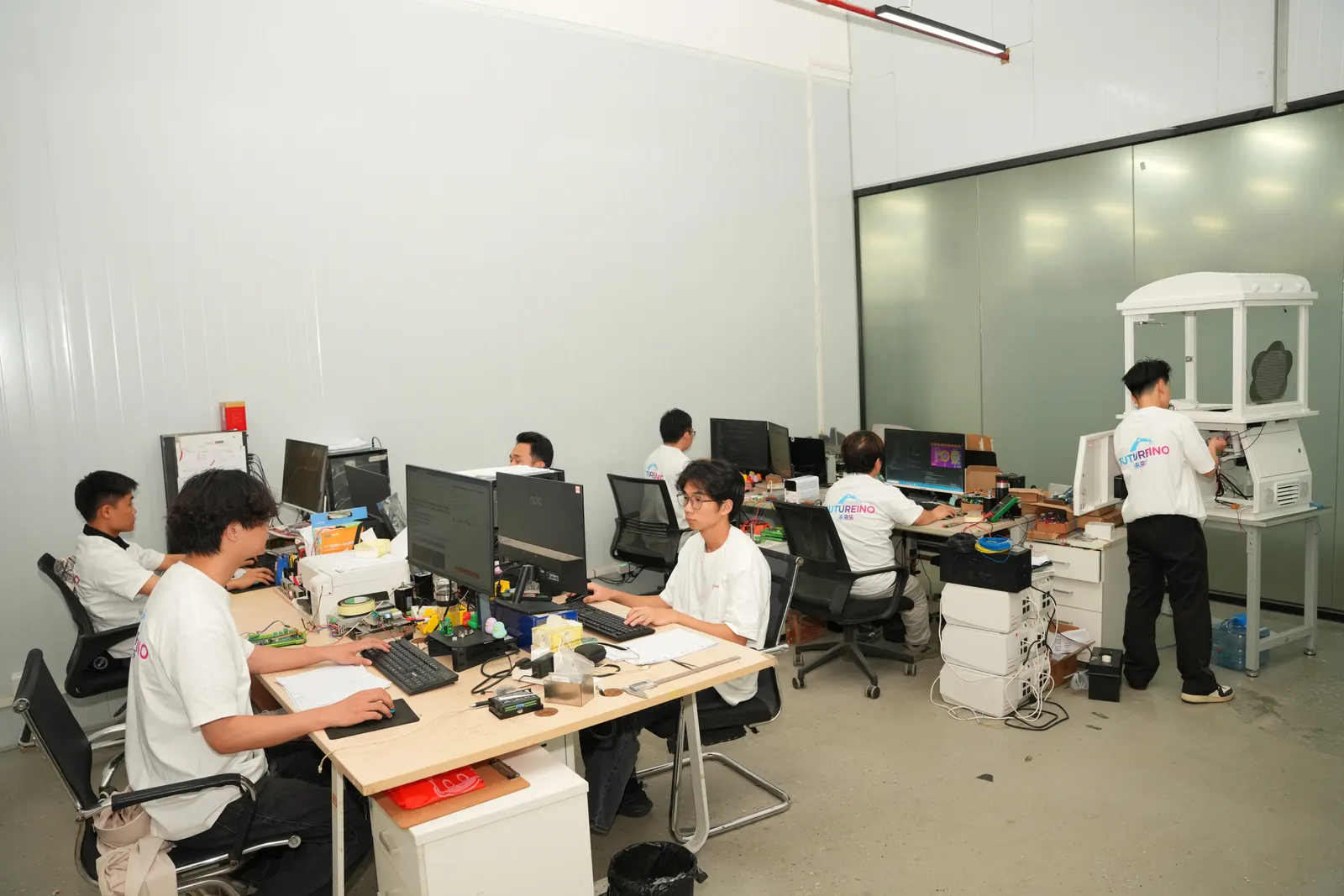
The reason we can be this specific about what the software does and does not do is that our own engineers wrote it. Details on branding, interface language and bespoke builds are in our guide to custom vending machines, and the company background, factory and Dubai sales office are covered in who Futureino is. A reseller can repeat a brochure. Ask them which layer their AI sits in and the conversation ends quickly.
Want the machines ranked rather than the technology explained? See the best AI vending machines in 2026, sorted by what the AI actually does.
If the practical question behind all of this is whether the connected machine is worth its price at your site, that is answered separately in smart vending machines versus traditional ones, including the two situations where we would tell you to buy the simpler machine.
Frequently Asked Questions
Is an AI vending machine just a vending machine with a touchscreen?
Usually, yes. A touchscreen is a menu, not intelligence. The label is only earned when software changes the product itself: a generative model that restyles a photo, or a converter that turns a chosen design into a print path. Ask the supplier which of the two their machine does.
Does an AI vending machine need an internet connection to work?
It needs one for card payments, remote reporting, and content updates. The style generation on the AI Photo Booth runs on the machine itself, so image processing does not depend on the venue Wi-Fi. A dropped connection usually stops sales at the payment step, not at the AI step.
Can an AI vending machine recognise customers or track faces?
Not on our machines. Futureino does not ship facial recognition, age estimation, or demographic profiling. The camera in the AI Photo Booth exists to take a picture the customer asked for and style it. Anything beyond that creates privacy obligations most operators are not equipped to carry.
Do the AI features make the machine more expensive?
The software is not what you pay for. An AI Photo Booth costs $5,300 to $6,000 EXW because of the dye-sublimation print engine, the cabinet and the display. A Perfume Station with no AI at all costs $1,400. Hardware sets the price; software rides along with it.
What happens if the AI part fails? Does the machine stop selling?
It depends on the machine, and you should ask before buying. ChocoArt keeps selling from its built-in library of 200 ready-made designs if custom image conversion is unavailable. On the AI Photo Booth the styling is the product, so a software fault there is a downtime fault. Both report the error remotely.
Which machine in the range has the most real AI in it?
The AI Photo Booth. It runs an actual generative image model that produces a new picture from the customer's photo in seconds. ChocoArt comes second, converting an uploaded image into a printable chocolate path. Everything else in the catalogue is robotics, sensing and payment software rather than machine learning.
See what the machines actually do
Full spec sheets, cycle times, capacity and factory-direct pricing for every robotic and AI machine we build, or send us your venue and we will tell you which one fits.